
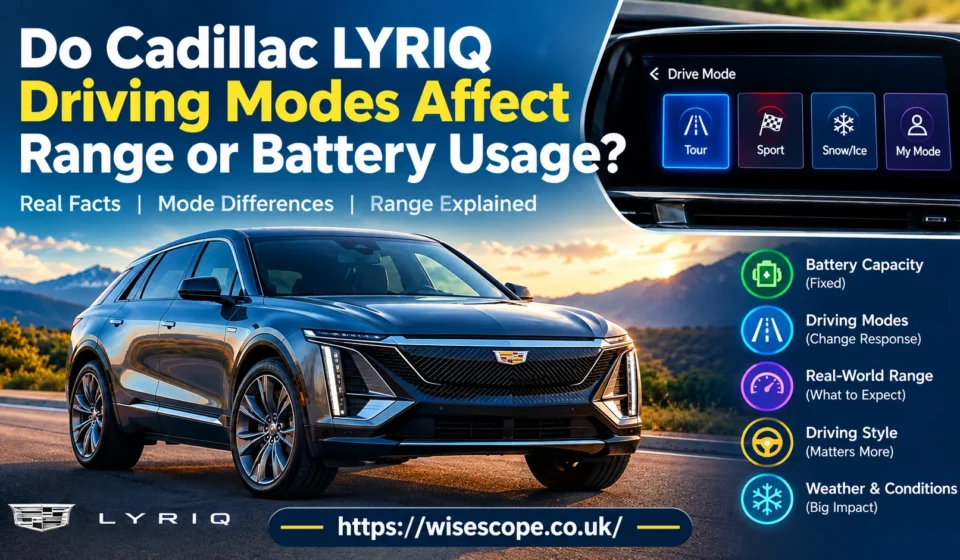

You’re sitting in your Lyriq, thumb hovering over that little mode menu on the screen, and a small voice in your head asks: does it actually matter which one I tap? Or is it just a fancy toggle that changes the mood lighting and nothing else?
Fair question. And here’s the honest answer: do the driving modes in Cadillac Lyriq offer different ranges or battery usages? Yes, they do — just not in the way most people picture it.
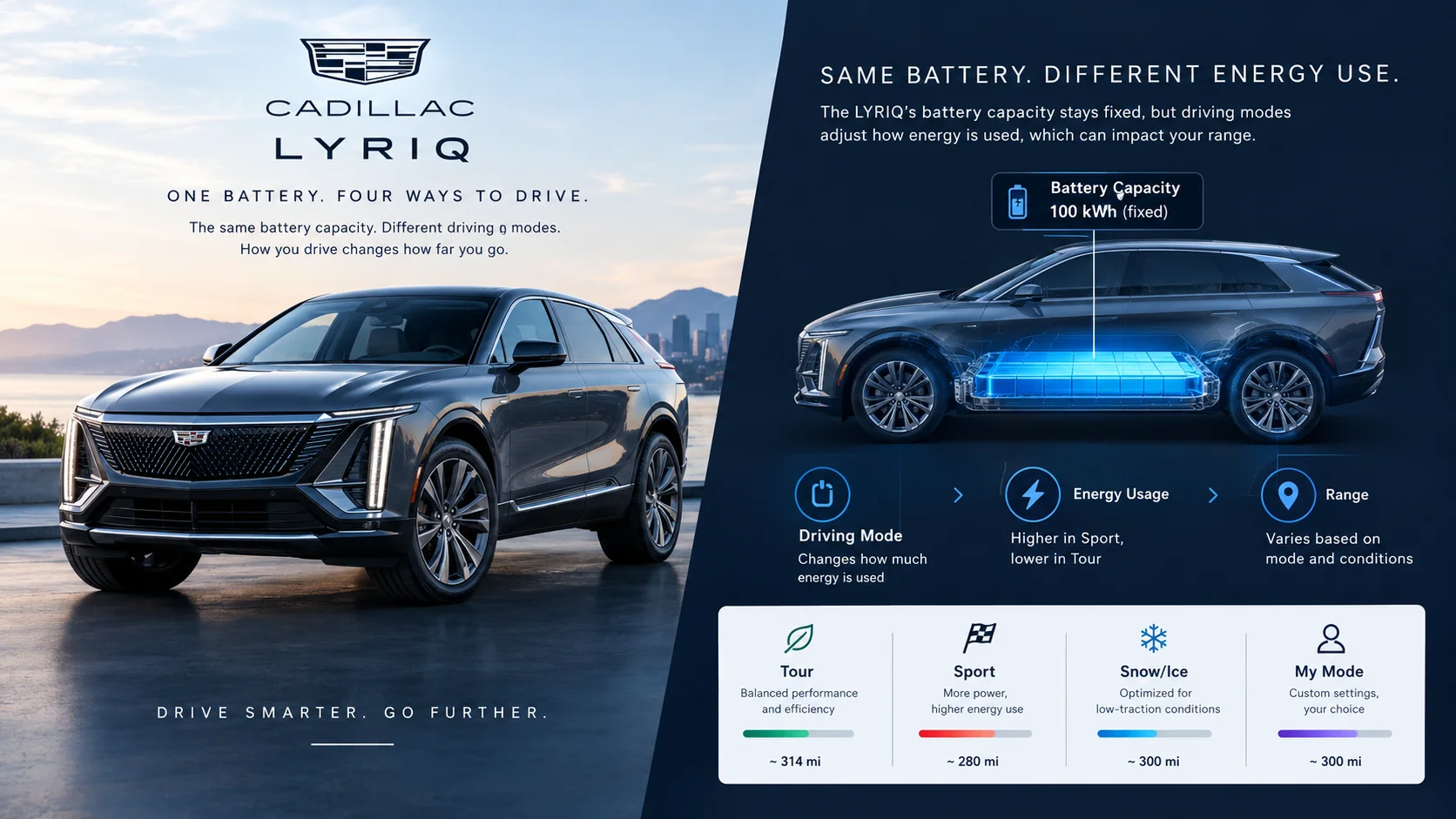
The battery pack itself doesn’t shrink or grow depending on what you pick. It stays exactly the same size, every single time. What changes is how fast the car burns through the energy sitting inside that pack, and that comes down to throttle response, regenerative braking behavior, and traction control — not the battery.
If you just picked up a Lyriq, or you’re still deciding, you’ve probably already spotted that menu — Tour, Sport, Snow/Ice, My Mode.
Most people tap through it once, pick whatever feels good, and forget about it. But if you’ve owned an EV for more than a week, you already know the truth: even the smallest setting can quietly eat into how far you get on a charge.
Pick the wrong mode for the wrong moment, and you could watch real miles disappear off your range estimate. Pick the right one, and drive it with a bit of common sense, and you’ll land a lot closer to the number printed on your window sticker than you’d expect.
So let’s actually open the hood on this — what each mode is doing behind the scenes, what Cadillac itself says about them, and what really moves your range more than the mode selector ever will.
Quick Answer
- Battery: Fixed at 102 kWh (usable) in every Lyriq trim. It never gets bigger or smaller based on the mode you choose.
- Driving modes: Change throttle response, regenerative braking behavior, steering feel, and traction control — not the battery’s actual size.
- Range: Tour Mode tracks closest to the EPA-estimated figures. Sport Mode can reduce real-world range if driven aggressively. Snow/Ice Mode trades a little efficiency for safer traction.
- Driving style: Matters more than the mode itself. Gentle acceleration in Sport Mode can outperform aggressive driving in Tour Mode.
- Weather: Cold temperatures reduce range more than any mode selection, mainly due to how batteries chemically behave in low temperatures and extra cabin heating demand.
Understanding the Lyriq’s Battery Before You Talk About Modes
Before we get into modes, it helps to understand what you’re actually working with — because a lot of the “range confusion” people run into has nothing to do with driving modes at all.
The battery. The Cadillac Lyriq sits on General Motors’ Ultium platform, the same underlying architecture used across several GM electric vehicles. Across its production run, the Lyriq has used a 102 kWh (gross) Ultium pack, with roughly 100–102 kWh usable, depending on the model year and software calibration.
This pack size is shared across trims — it isn’t a “bigger battery for more money” situation like you sometimes see with other EVs.
RWD vs. AWD. The Lyriq comes in two drivetrain layouts. The single-motor rear-wheel-drive version uses one electric motor and is the more efficient of the two.
The dual-motor all-wheel-drive version adds a second motor over the front axle for better traction and quicker acceleration, but that added motor, extra weight, and higher performance ceiling mean it uses slightly more energy to cover the same distance. Both versions use the same battery pack size — the difference in range comes entirely from the drivetrain, not the battery.
Model year differences. Cadillac has adjusted the Lyriq’s EPA range slightly across model years as software, aerodynamics, and available wheel packages have changed.
Earlier model years and later ones don’t always carry identical EPA numbers, even on the same drivetrain, so it’s worth checking the window sticker or Cadillac’s own specs page for your specific model year rather than assuming every Lyriq is rated the same.
Wheel and tire configuration. This is one factor a lot of buyers overlook. The Lyriq is offered with different wheel sizes, and larger wheels with lower-profile, wider tires generally increase rolling resistance and aerodynamic drag.
That means a Lyriq on larger, sportier wheels will typically have a slightly lower EPA range rating than the same trim on smaller, more efficient wheels — independent of any driving mode.
EPA range vs. actual driving range. EPA range figures come from standardized lab testing designed to let shoppers compare EVs on a level playing field. They’re useful for comparison, but they don’t account for your specific climate, terrain, speed, or driving habits.
Independent testing by automotive outlets, and real-world reports from owners, often land below the EPA number — particularly in sustained highway driving, where high, constant speeds are one of the biggest range killers for any EV, not just the Lyriq.
None of these factors — drivetrain, wheels, model year, or the gap between EPA and real-world figures — has anything to do with which driving mode you’re in. They set your baseline range. Driving mode then influences how close you get to that baseline on any individual trip.
| Lyriq Version | Battery Pack (Usable) | EPA-Estimated Range | Independent Test Result |
|---|---|---|---|
| Single-Motor RWD | ~100–102 kWh | 314–326 miles (varies by model year/wheels) | 270 miles — Car and Driver highway range test |
| Dual-Motor AWD | ~100–102 kWh | 307–319 miles (varies by model year/wheels) | 220 miles — Car and Driver highway range test |
Independent test results reflect specific test conditions (in this case, sustained highway driving) and are not official EPA figures. Your own results will vary based on speed, weather, and driving style.
As you can see, the battery size is essentially the same across both versions. The range gap comes from the drivetrain, wheel setup, and test conditions — not from anything related to driving modes.
What Cadillac Says About Driving Modes
Cadillac markets the Lyriq’s driving modes through its Driver Mode Control system, and the way the brand describes them is fairly straightforward: each mode is built around a driving priority, not a fuel-saving gimmick. Here’s the simplified breakdown, based on how Cadillac positions each mode:
| Mode | Main Purpose | What It Changes |
|---|---|---|
| Tour | Everyday driving | Smooth, balanced throttle response and steering feel |
| Sport | More responsive, engaging driving | Sharper throttle response, firmer steering |
| Snow/Ice | Safer driving on slippery roads | Softer acceleration and more conservative traction control |
| My Mode | Personal preference | Fully customizable throttle, steering, and regen settings |
Notice that “range” or “battery savings” isn’t listed as the primary purpose of any mode. That’s an important distinction. Cadillac isn’t selling Tour Mode as an “Eco Mode” the way some other automakers frame their efficiency settings —
It’s positioned as the default, everyday setting that happens to be the most efficient because of how gently it’s tuned. The range benefit is a side effect of the driving character, not the headline feature.
What Are the Cadillac Lyriq’s Driving Modes?
Cadillac’s Driver Mode Control system gives Lyriq owners a handful of selectable modes, each tuned for a different priority — comfort, performance, safety, or personal preference.
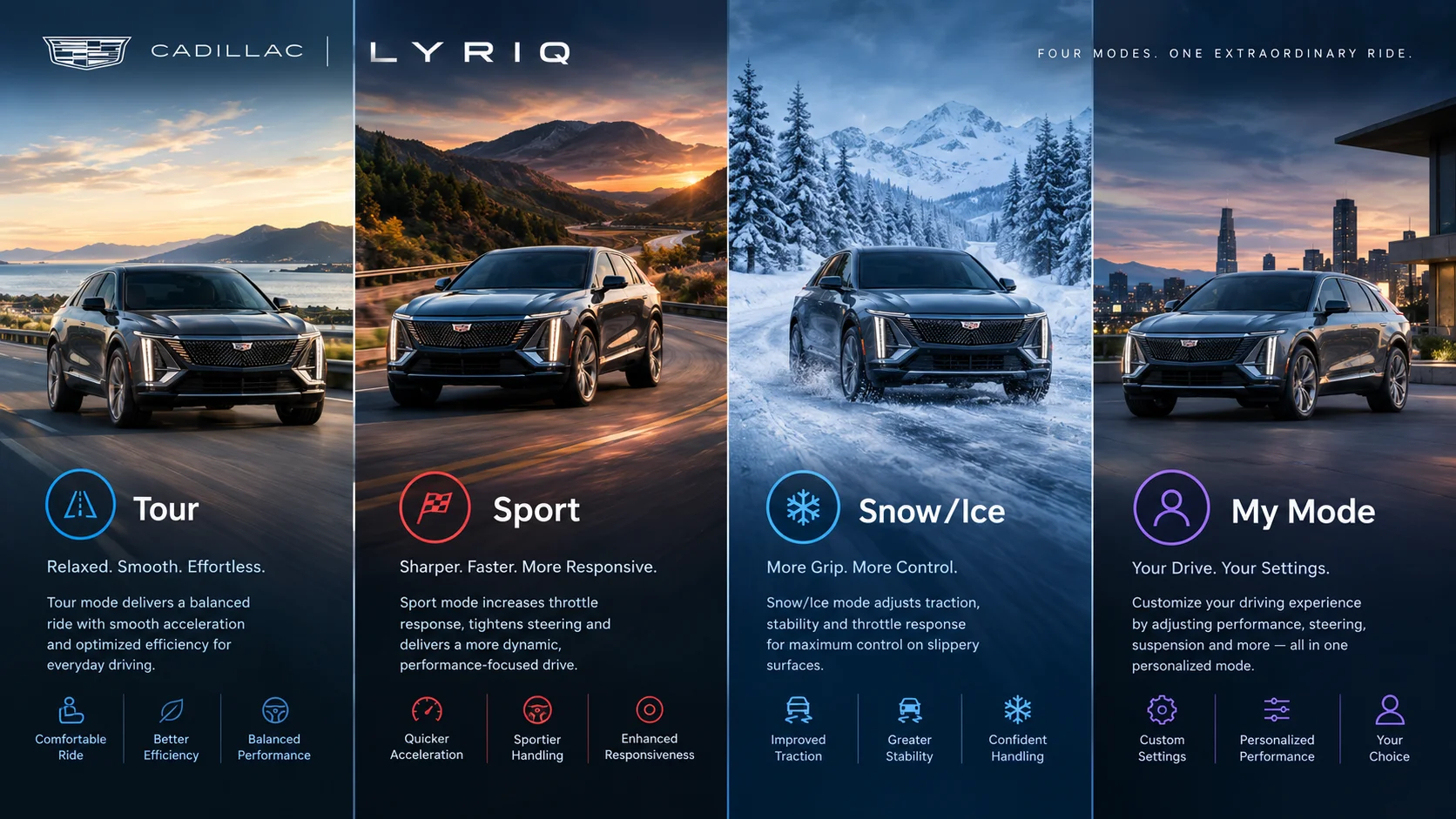
Tour Mode
Tour Mode is the Lyriq’s default setting, and it’s the one most owners end up using for daily driving. It smooths out throttle response, keeps regenerative braking balanced, and avoids sending sudden bursts of power to the wheels.
The result is a calm, predictable ride that also happens to be the most energy-efficient option available.
Because it’s tuned this way, Tour Mode is the mode that gets you closest to the EPA-estimated range. If maximizing every mile matters to you, this is the setting to leave on for commutes, errands, and long road trips.
Sport Mode
Flip over to Sport Mode, and the Lyriq feels like a different vehicle. Acceleration sharpens, the steering firms up, and the SUV responds to the throttle almost instantly. It’s genuinely fun to drive — but that responsiveness comes from the motor working harder, more often.
Depending on how aggressively you use that extra power, Sport Mode can noticeably reduce your real-world range compared to Tour Mode. Some drivers barely notice a dip if they still drive gently. Others who lean into the acceleration regularly can see a meaningfully shorter range on the same charge.
Snow/Ice Mode
Snow/Ice Mode isn’t built around speed or efficiency at all — it’s built around control. Power delivery becomes softer and more gradual to reduce wheel slip on slippery roads, and traction management becomes more conservative.
Energy usage in this mode tends to sit somewhere between Tour and Sport, but honestly, the mode itself usually isn’t the biggest factor in cold-weather range loss.
Cold temperatures affect battery chemistry directly, which is why Lyriq owners typically see a bigger range drop in winter regardless of which mode they choose.
My Mode
My Mode is the customizable option. It lets you dial in your own combination of throttle response, steering weight, and regenerative braking strength.
Set it up like Tour Mode, and you’ll get similar efficiency. Set it up like Sport Mode, and you’ll trade some of that range back for performance. It’s essentially a blank canvas — the range impact depends entirely on how you configure it.
So, How Big Is the Real Difference?
This is where a lot of articles get vague, so let’s be specific.
Based on owner reports and real-world testing, the difference between Tour Mode and Sport Mode can range anywhere from a small, barely noticeable gap to a swing of 30 to 60 miles on a full charge, depending on how the car is actually driven in each mode. Gentle acceleration in Sport Mode won’t hurt your range much at all. Constant hard acceleration will.
A simple way to think about it:
| Driving Mode | Throttle Response | Regenerative Braking | Typical Range Impact | Best Used For |
|---|---|---|---|---|
| Tour Mode | Smooth and gradual | Balanced | Closest to EPA-rated range | Daily commuting, road trips |
| Sport Mode | Sharp and immediate | Reduced (to allow free-flowing acceleration) | Can reduce range by roughly 10–25% under spirited driving | Fun drives, quick merges, overtaking |
| Snow/Ice Mode | Soft and gradual (limits wheel slip) | Conservative | Small efficiency trade-off | Icy or snowy roads |
| My Mode | Fully customizable | Fully customizable | Varies based on your settings | Drivers who want full control |
The takeaway here is simple: the mode sets the ceiling and floor for efficiency, but your right foot decides where you actually land inside that range.
Driving Mode vs. Driving Style: Which One Actually Wins?
Here’s a scenario that makes the point clearly: put a Lyriq in Tour Mode and drive it aggressively — hard acceleration, late braking, high speeds — and compare it to the same car in Sport Mode, driven gently and smoothly.
In that matchup, gentle driving in Sport Mode will often come out ahead on range compared to aggressive driving in Tour Mode. The mode sets the character of the car’s response, but it doesn’t override how much energy your right foot actually demands.
| Driving Style | Tour Mode Result | Sport Mode Result |
|---|---|---|
| Gentle, steady driving | Near-EPA range | Only a small range drop |
| Mixed city and highway | Slightly below EPA range | Noticeable range drop |
| Aggressive, frequent acceleration | Below EPA range | Significant range drop (up to 25%) |
The point isn’t that mode doesn’t matter — it does. It’s that mode and driving style work together, and driving style usually carries more weight. Choosing Tour Mode is a good habit, but it’s not a substitute for driving smoothly. Choosing Sport Mode isn’t automatically a range killer, either, if you keep your inputs gentle.
What Affects Lyriq Range More Than Driving Mode?
If you really want to protect your range, the driving mode is only one piece of a much bigger puzzle. Here’s what tends to move the needle just as much, if not more:
- Driving speed. Wind resistance increases sharply at higher speeds. Sustained highway speeds above 70 mph are one of the single biggest range killers in any EV, including the Lyriq.
- Hard acceleration. Flooring the accelerator, even briefly, draws a large burst of energy from the battery. Repeated hard launches add up fast, in any mode.
- Outside temperature. Cold weather affects the battery’s chemistry directly, temporarily reducing how much usable energy it can deliver. Hot weather can also reduce range slightly, mainly through added air conditioning use.
- Heating and A/C use. Climate control doesn’t come from a separate fuel source like it does in a gas car — it draws directly from the same battery that powers the wheels.
- Tire pressure. Underinflated tires increase rolling resistance, which quietly increases energy consumption no matter which mode you’re in.
- Road and terrain. Hills, rough pavement, and stop-and-go traffic all demand more energy than flat, smooth roads.
- Vehicle load. Extra passengers, cargo, or towing add weight, and more weight means more energy needed to move the vehicle.
- Wheel and tire setup. As mentioned earlier, larger wheels and wider, lower-profile tires generally reduce efficiency compared to smaller, more aerodynamic wheel packages.
- Battery temperature. Beyond outside air temperature, the battery’s own operating temperature affects how efficiently it can charge and discharge, particularly right after a cold start.
- Driving style. Smooth, anticipatory driving — easing into the throttle, coasting toward stops, avoiding unnecessary braking — consistently outperforms reactive, stop-start driving.
Put these factors next to the driving mode selector, and it becomes clear why two Lyriq owners in the exact same mode can get noticeably different range on the same day.
The Role of Regenerative Braking
One feature working in the background across every mode is regenerative braking, and it’s worth understanding on its own, separate from the mode debate.
What it is. In a gas car, slowing down wastes energy as heat through the brake pads. In the Lyriq, the electric motor can run in reverse when you lift off the accelerator or apply the brakes, acting like a generator instead of a motor.
How the energy gets recovered. As the wheels turn the motor during deceleration, it generates electricity, which flows back into the battery pack instead of being lost as heat.
It’s not a huge amount of energy compared to what you use to accelerate, but over the course of a normal drive with lots of slowing down — traffic lights, stop signs, exit ramps — it adds up.
What One-Pedal Driving does. Many Lyriq owners turn on One-Pedal Driving, a setting that increases how aggressively the car uses regenerative braking. With it on, lifting off the accelerator slows the car down noticeably, often enough that you rarely need to touch the brake pedal in normal traffic.
Its role in city and stop-and-go driving. This is where regenerative braking, and One-Pedal Driving in particular, makes the most practical difference. Stop-and-go traffic involves constant slowing down, which means constant opportunities to recover energy rather than waste it as brake heat.
One honest caveat worth stating clearly: regenerative braking is not a guaranteed way to add extra range on top of what you’d otherwise get. It’s a way to reduce waste during a drive you were already going to make.
It won’t overcome the effect of driving too fast, hauling a heavy load, or blasting the heater on a freezing morning — it simply makes normal, everyday driving somewhat more efficient than it would be without it.
A Quick Myth to Clear Up
A lot of new EV owners expect one single mode to dramatically transform their range, the way flipping a switch might in their head. In practice, the gap between modes during normal, everyday driving is usually smaller than people expect.
The biggest efficiency swings almost always come from driving behavior, weather, and speed — the mode selector plays a supporting role, not the starring one.
Real-World Example
Picture two coworkers who both drive a Lyriq to the same job, 40 miles round trip, five days a week.
One of them leaves the car in Tour Mode, keeps a steady speed on the highway, and uses One-Pedal Driving in traffic. The other prefers Sport Mode, accelerates quickly at every green light, and enjoys the extra punch on the highway on-ramp.
Over a single day, the difference might only be a few miles. But over a full week of commuting, that gap adds up — and it becomes the difference between charging the car every other night versus needing a top-up every single evening.
Neither driver is “wrong.” One is optimizing for range, the other for enjoyment. The mode you choose should match what actually matters to you on any given drive.
Tips to Get the Most Range Out of Any Mode
- Stick with Tour Mode for long trips. It gives you the best shot at hitting the EPA-estimated range.
- Use One-Pedal Driving in city traffic. It puts more energy back into the battery instead of wasting it as brake heat.
- Avoid hard, repeated acceleration, even in Sport Mode. Smooth throttle input saves more energy than most people expect.
- Precondition the cabin while plugged in. Heating or cooling the car before you unplug it saves battery that would otherwise go toward climate control on the road.
- Keep an eye on tire pressure. Underinflated tires increase rolling resistance and quietly reduce range in any mode.
- Expect lower range in winter, no matter what mode you choose. Cold weather affects the battery itself, not just how you’re driving.
Final Thoughts
So, do the driving modes in Cadillac Lyriq offer different ranges or battery usages? Yes — but the battery pack itself never changes. What changes is how efficiently you’re using the energy inside it. Tour Mode is your best friend for daily driving and long trips.
Sport Mode is there when you want to have fun, at the cost of a bit of range. Snow/Ice Mode keeps you safe when the roads turn against you. And My Mode lets you build your own balance between the two.
At the end of the day, the mode you pick matters less than how you actually drive once you’re in it. Combine the right mode with smart driving habits, and you’ll get a lot closer to that EPA number than you might expect.
Sources
- Cadillac’s official Lyriq product and specifications pages, for battery pack details and Driver Mode Control descriptions
- The U.S. Environmental Protection Agency (EPA), for standardized EV range ratings referenced in the battery and range comparison table
- Car and Driver’s independent Lyriq highway range testing, cited in the “Independent Test Result” column of the range table
- General owner-reported driving experience and industry EV efficiency reporting, used for the practical range-impact estimates throughout this guide
Range and efficiency figures can change across model years and trims. Always check your specific Lyriq’s window sticker or Cadillac’s current specifications for the most accurate numbers for your vehicle.
FAQs About Do the Driving Modes in Cadillac Lyriq Offer Different Ranges or Battery Usages?
1. Do driving modes affect Cadillac LYRIQ range?
Yes, driving modes can affect energy use, but driving style and road conditions usually have a bigger impact.
2. Does Sport Mode use more battery on the LYRIQ?
It can, especially when you use its quicker acceleration frequently.
3. Which LYRIQ mode is best for everyday driving?
Tour Mode is designed for normal everyday driving and a smooth ride.
4. Does Snow/Ice Mode improve LYRIQ traction?
Yes. It adjusts acceleration and torque response to help reduce wheel slip on slippery roads.
5. Does My Mode affect LYRIQ battery usage?
It can, depending on the settings you choose and how you drive.
6. Does One-Pedal Driving improve LYRIQ range?
Regenerative braking can return energy to the battery, but actual range depends on driving conditions and driving style.
